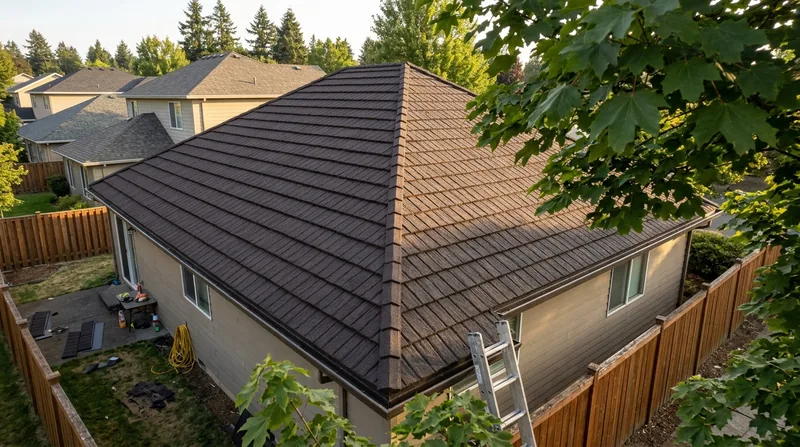




Portland sits where the Willamette meets the Columbia, ringed by the forested West Hills and the Cascade foothills, and that setting shapes every roof decision here. About 36 inches of mostly cool-season rain falls from October to May, moss and needle litter build on shaded slopes, and Douglas firs, bigleaf maples and western red cedars overhang roofs from Irvington to Sellwood. Stone-Coated Steel Roofing in Portland gives you the look of cedar shake or slate on a Craftsman bungalow, Tudor or ranch, backed by steel instead of wood. The panels shrug off wind, carry a Class A fire rating, and weigh a fraction of tile or concrete. We install, repair and replace these systems across the city and the surrounding suburbs. For a broader look at how this fits our full lineup, see metal roof installation.
Why Stone-Coated Steel Fits Portland's Older Housing Stock and Wet Winters
Portland's building stock is a patchwork of eras, and each one asks something different of a roof. The 1900s-1930s Craftsman bungalows, Foursquares and Queen Annes in Irvington, Alameda, Laurelhurst and St. Johns have moderate-to-steep gable roofs that originally carried wood shake. Stone-coated steel in a shake profile matches that look without the rot, splitting and moss that plague real cedar in this climate. The English Tudor and Colonial homes in Eastmoreland and the West Hills want slate, and the slate-profile panels deliver it at a fraction of the structural load. Ranches and mid-century moderns across Southeast Portland, Lents, Gresham and Multnomah Village often have low pitches where a textured panel reads well, and the two-story subdivisions in Beaverton, Hillsboro, Tigard and Happy Valley benefit from a roof that won't need re-shingling in 20 years.
- The textured surface sheds the cool-season rain that drives rot into wood shake and lifts composition shingles.
- Steel cores resist the moss and algae growth that stains shaded north slopes under the fir canopy.
- Class A fire rating matters more each summer as wildfire smoke and ember risk push into the foothills.
- The panels hold up to east winds out of the Columbia Gorge and the occasional ice storm that drops limbs.
For a city that gets 36 inches of rain and a dry, smoky summer, a stone-coated steel roof is one of the few options that handles both ends of the year.
Key info: A shake-profile stone-coated steel roof on a 1920s bungalow in Laurelhurst keeps the historic street look while eliminating the annual moss scraping and shake replacement that cedar demands in this climate.
Before any contract is signed, confirm what your local building department requires, since roofing permit thresholds and inspection rules vary by jurisdiction. The City of Portland's Bureau of Development Services publishes permit guidance at portland.gov/bds.
How We Install Stone-Coated Steel on a Portland Roof
Stone-coated steel is not a panel you slap over old shingles and walk away from. The substrate, the underlayment and the flashing detail decide whether the roof performs through 20 wet seasons. We start by inspecting the deck, then build the system in a fixed order so nothing gets covered before it is right.
- We inspect the roof deck and framing, and we replace any soft sheathing before anything else goes down.
- We install a high-temperature underlayment rated for the panel and the local climate.
- We set new flashing at chimneys, skylights, valleys and sidewalls, because these are where leaks start.
- We lay out the panels from a chalk line so the courses stay true on long, steep gable runs.
- We fasten each panel to the manufacturer's spec and seal the penetrations as we go.
- We walk the roof, check every edge and ridge, and clean the gutters before we leave.
On a steep Tudor in Eastmoreland, that means staging and fall protection planned around the pitch, not improvised on the day.
Key info: A ranch in Milwaukie with a low-pitch roof and heavy fir litter overhead gets a panel layout that keeps debris moving to the gutter line, paired with gutters sized for a metal roof so the runoff clears the foundation.
Stone-Coated Steel Profiles and How They Compare
Not every stone-coated system suits every house, and the profile you pick drives both the look and the cost. Here is how the common approaches stack up for Portland homes.
| Approach | Description | Best for |
|---|---|---|
| Shake profile | Textured panels that mimic cedar shake with deep shadow lines. | Craftsman bungalows and Foursquares in Irvington, Alameda and Sellwood. |
| Slate profile | Flat, rectangular panels with a stone finish and clean courses. | Tudor and Colonial homes in Eastmoreland and the West Hills. |
| Tile profile | Curved or scalloped panels with a Mediterranean look. | Homes where a tile look is wanted without the weight of real tile. |
| Shingle profile | Small, overlapping panels that read as composition shingle. | Ranches and mid-century homes across Southeast Portland and Gresham. |
| Retrofit over shingles | New steel system installed over an existing single layer where code allows. | Subdivision homes in Beaverton, Hillsboro and Tigard ready for a long-life roof. |
If you are weighing a retrofit, read up on metal roof over shingles before you commit, because local code limits how many existing layers you can cover.
Stone-Coated Steel Roofing Cost in Portland: What to Expect
Stone-coated steel pricing starts around $9 per square foot installed, and that figure is a starting point, not a flat rate. The real number depends on the pitch, the number of valleys and penetrations, the deck condition and how much tear-off the job requires. A simple gable ranch in Tualatin sits near the low end, while a steep, cut-up Tudor roof in the West Hills with multiple chimneys and skylights pushes toward the top. Getting two or three written estimates is smart, because it lets you compare scope line by line instead of just the bottom number. Our full pricing overview breaks down how each factor moves the total.
Stone-Coated Steel Roofing Near Me: How to Vet a Contractor Near Portland
Hiring a roofer is a decision you live with for decades, so treat the vetting as seriously as the roof itself. Start with licensed and insured status, and ask for the certificate rather than a verbal assurance. Get at least two written estimates with the same scope so you can compare fairly, and ask for references from jobs in your part of town. Confirm who pulls the permit, since roofing permits are commonly required for a full replacement and the rules vary by jurisdiction. If your home sits in a historic district or an HOA, check design review rules on panel profile and color before you order material. Reach out through our contact page when you are ready to talk through your roof.
Stone-Coated Steel Roofing in Portland: Pricing Guide
| Service | Price | Details |
|---|---|---|
| Stone-coated steel, shake or shingle profile | Starting at $9/sq ft | Includes tear-off, underlayment, panels and standard flashing on a typical pitched roof. |
| Stone-coated steel, slate or tile profile | Starting at $11/sq ft | Premium profile and finish, with more layout time on steep or cut-up roofs. |
| Retrofit over existing shingles | Starting at $7/sq ft | Skips tear-off where code allows, lowering disposal cost and labor hours. |
| Complex or steep-pitch roof | On estimate | Steep pitch, multiple valleys and chimneys need an on-site look before pricing. |
| Travel | Included | In Portland and surrounding areas, no separate call-out or mileage fee. |
| Estimate | Free | Response within 24h at (971) 754-2587, no obligation to book. |
Indicative pricing, the exact cost depends on square footage, finish, and site access. Free personalized estimate within 24h at (971) 754-2587.


